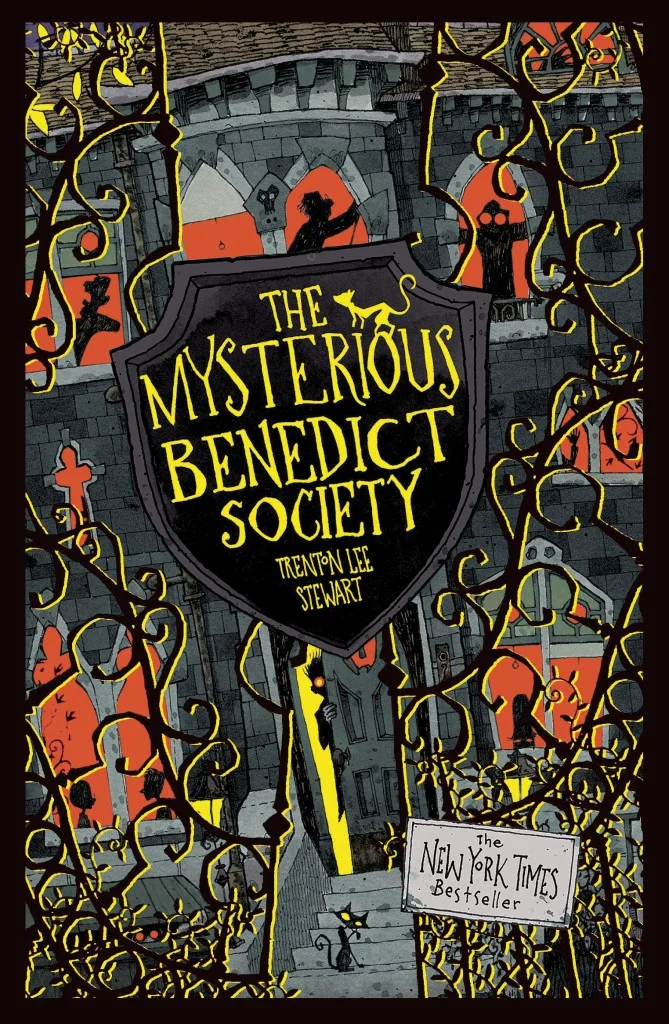
I write a lot of children’s fiction, which is why I keep track of popular series for that target audience and read them myself from time to time. Because I am, of course, not the target audience. I’m a 28 year old man. These books were not written for me, and I’ll try to keep that in mind as I write this review.
I also like to read books that received a (recent) adaptation, be it a film or a Netflix series. It’s fun to see how they change and streamline the story to make it work in a different medium, and very instructive too.
Those two reasons made me pick up these books a few months ago. A popular series of books that pop up all over the place, and an adaptation I can compare it to afterwards. I read all four novels from The Mysterious Benedict Society after each other.
In this article I will briefly give my thoughts on these books. It’s not a full “review”, because I really didn’t have enough to say about them to warrant it.
It contains no spoilers until the spoiler barrier (about halfway)
What’s the idea?
The first book starts with someone (Reynie) taking a mysterious test. He has to go to a building and answer (trick) questions, then he’s selected and goes to a new building with a new challenge, and so forth. You meet some more kids along the way who are just as confused about the purpose of these tests.
After a few chapters of this, the tests are done. You won’t be surprised to hear that the group of kids that were introduced to you have all made it to the end. They are selected … but for what? A secret mission! One that needs very clever kids with unique skill sets! A person called Benedict created the tests, informs them about the mission, then sends them on their way.
They call themselves The Mysterious Benedict Society and try their best to fulfill this mission.
It’s hard to say any more without spoiling anything. It’s even harder to say, of course, what the other three books are about.
All I can say is that the first book felt good, and purposeful, and streamlined. And the other books felt like afterthoughts, reaching for some reason to justify their existence. About half of the time they’re just repeating what made the first book good, with minor differences. The other half of the time you wonder how on earth this plot is part of the same series as the first book.
What did I like?
The first book starts off strong. It instantly makes you interested about the tests and their purpose, revealing just enough at every stage. It was definitely the moment when I was reading the most chapters each night.
The remainder of the first book continues this kind of narrative very well. There’s a nice structure to it all, a sensible mission with nice story beats, a predictable purpose but also enough variety and tension along the way. And when the first book ends, it feels like a good story well-told, and (almost) everything is wrapped up nicely.
The prose is fine. Not bad, also not outstanding. There were some funny lines and phrasings here and there, so I’m moving this to a positive. It’s easy to read, although it does sprinkle in some difficult words on purpose from time to time. Besides that, I didn’t notice anything more about the writing style, be it good or bad.
It does mean that there isn’t a very distinct voice or personality behind the writing. Some parts could feel rather bland, neutral, dry. As if someone tried to tell a pretty basic story in the most basic inoffensive way possible. After reading all that, I have no clue about who the author might be, who the narrator/human is behind the beat-for-beat story.
This isn’t too bad, though, because the personality in these stories comes from the 4 kids who form the Mysterious Benedict Society. I thought this was handled quite well. The children all have clear traits that make them unique. They have their own “roles” in the story, their super powers if you will, without it ever feeling too cliché or contrived. It feels quite natural, it fits their personalities, and their strengths are used often enough that they never come out of nowhere.
It’s fitting that the books are named after that group of kids, because they are the heart of the story and the only reason I kept reading. (I mean, the books could have been named after the mission, after Benedict himself, or something like “The Mysterious Test”. But it’s named after the 4 main characters and that’s the right choice.)
The story focuses a lot on “being smart/clever” and having “a strong desire for the truth”. They’re nice messages and implemented quite well. I can see how it might inspire kids to do their best to be curious, to find out the truth, to work hard on skills.
There are, also, a lot of riddles throughout all the books. Literally from start (with that mysterious test) to finish. Most of them are quite well done.
I’m a big puzzler myself and even create escape rooms that I sell in my store, so I can’t say the riddles interested or challenged me (I found them too easy and predictable). But I can see them being the right level for the target audience, and that’s what matters. I mean, if you want a huge problem solving challenge, you don’t read a book but an escape room/game/other experience. Making the riddles in this book extremely hard would defeat the purpose—you’re using the wrong medium to give someone puzzles!
What did I not like?
As stated earlier, I feel the first book was definitely the best. The writer probably had this great plan for the first book, which he worked on for years, until a publisher finally accepted and he became successful. But then … there was no plan for anything more. There isn’t really anything in there that warrants more books, and it shows.
Book two is still quite good. The author found a nice trick to hit some of the same fun beats as the first book, while also changing it up just enough. But book three and four bored and confused me, and I ended up reading less and less each night until I was finally done. With a shrug.
And so I wondered: why is that? The characters are still the same. The writing is still fine, the core of the story and the nice ideas are still there. But why does it feel like book 1 was very good and the others really don’t need to exist?
I think it comes down to a few issues.
- As I said, the characters are still the same. There is an attempt at growth or change, but it’s one that just annoyed me by how transparent and bad it was. In the end, these kids have their “roles”, they stick to it, and that’s all they do for four books. Even though the fourth book aged them up by many years, probably because it came out much later than the others.
- Only one of the characters gets growth, and it’s one that feels like it was ripped from a different story. The wrong story. Because this story started as four people who are clever and have practiced useful skills, completely realistic. Their mission, although stretching the imagination, is also presented as realistic and could happen in real life. But then one of the characters just develops magical powers? What? And it becomes almost the only reason for the later books existing?
- The only “enemies” are caricature repetitive enemies that also don’t grow, or change, or develop. They just return, and return, and return, and they never really deal with them until the last book. It felt very repetitive, it felt like all creativity had run dry at some point, and now we were just doing the same things over and over.
Conclusion
Are the later books bad? No, I don’t think so. The writing is fine, there are some nice ideas in there, and some plots are developed further. I actually finished them all, so that’s something.
But when you look at it as a series, as a continuation of that first book, then I can only feel very confused and disappointed. I felt the first book was very good; I felt the others ran away in a different direction. One that did not interest me much.
I would recommend the first book to anyone, especially kids/teenagers. It starts off strong, it stays strong, it ends strong. I felt it was the most funny of them all, but also the most interesting in terms of deeper themes it tried to introduce.
I would approach the other books with caution. I can’t … I can’t even say they are “not the same”, because they are very much “more of the same” in many ways. It’s just so confusing. Books 2, 3 and 4 are a mix of “this is so repetitive it’s boring” and “this is so out of nowhere and unfitting that I wonder what I’m reading” with few things in-between.
The first book, at least, introduces some interesting ideas wrapped in a plot that is fast and well-written. It should keep the target audience engaged while having them think about some of the riddles and clever tricks. It has some good messages for kids too, if you find such things important.
Those were my thoughts. I’ll try to see the Netflix adaptation soon and compare the two.
Spoiler Barrier
Now I’ll explain some of my thoughts above by giving examples from the books. That includes lots of spoilers, of course. Ye be warned!
So, Reynie is the clever one (and leader/pattern recognizer), Sticky is the one with amazing memory, Kate is the strong athlete, and Constance is the stubborn chaotic factor. Those are their “roles”. And they don’t change. The story tries to add some more dimensions to it, to maybe add a downside or development, but there really isn’t any.
Partially, of course, that stems from the fact that being smart is a very good thing with little downsides :p Of course you’re not going to change tactics when your smart brain has been solving all problems easily. But that’s the challenge of the writer, is it not? To find a story that does challenge your main characters, their beliefs, their skills, everything.
Reynie does a few weird things without a good explanation … and it leads nowhere. Sometimes he is a little less smart, and he’s disappointed with himself, and, well, that goes nowhere.
At some point a kind of jealousy angle is suddenly played up for Sticky, thinking Reynie is amazing and he’s stupid, but that also goes nowhere and has no strong foundation. I harbor a special hatred for three scenes in book 4 where Reynie purposely lies to Sticky/withholds information “to not pressure him”, which is stupid, and it’s especially stupid for someone supposed to be very smart. Of course it leads to this meaningless argument and distrust that lasts for exactly one chapter. It’s just filling space with things I don’t want to read, and ruining the belief that Reynie is a “clever person” in the process.
Kate’s “flaw” is that she’s so restless and strong that she acts before she thinks. Which, again, could have been a great part of the story, but it’s not really developed and goes nowhere. She just makes a bunch of mistakes, and people shrug and continue, because the other 90% of the time she has a superhuman level of fitness. Which can solve a lot of problems :p
And then we have Constance. In book 1 she is a bit annoying, but that’s on purpose and works well with the reveal at the end. (Her never-ending stubbornness helps the mission + she is revealed to be only two years old.) In later books, she gets … the powers of of mind reading and mind changing. This changes everything, of course. Those are massive powers, which come out of nowhere and suddenly introduce a sort of magic to a book that did not have it before. That’s why all the other books are very much focused on her and on that power.
It just feels so very different from what book 1 was doing. Everyone else is the exact same person doing the exact same things: Reynie solves everything and sees all the patterns, Sticky helps him with that by knowing all the facts, and Kate executes the plan with physical precision. And then you have Constance being annoying and sometimes reading minds.
And yes, in book 1, the Whisperer is a big deal. The fact that the “villain” is trying to change people’s minds is a big deal, so that’s why I was willing to believe that it fits with the rest of the story. But there’s a crucial difference. The Whisperer is not magic and it’s not presented as such. The book does a very good job, at the start, of explaining how you could change people’s minds and beliefs with just the right (secret) messages. This is actually mostly true, so it’s believable. The machine is presented as a marvel of engineering after many years of work and study.
Constance, without practice or intention, just starts to read minds and then change them. It’s never explained how she does it or why she develops it. There is no machine she builds; there is no logical or real-world explanation for how this goes. This is not the same. And so, the later books cheapen the first one, while, in my eyes, feeling like a different series. And three of the main characters are stuck on repeat, accidentally dropped in this new series.
While all this is going on, the same “enemies” (the Ten Men + that villain from book 1—the twin brother of Benedict, Mr Curtain) just keep returning. No background for them, no motivation, no development. They just survive everything, have infinite resources (… until they suddenly don’t in book 4), and keep coming back each book because tension was needed. It’s not interesting. It’s not fun. It’s not smart. You never really believe they would actually catch/harm the main characters.
And then you have Benedict’s character. He is very interesting in book 1, with his background, his personality, his narcolepsy. But he is basically completely gone in books 2, 3, and 4. In book 2, he is captured somewhere so they only rescue him at the end. In book 3, they end up in some prison separated from Benedict who rescues them at the end. In book 4, Benedict locks himself in the prison with Mr Curtain. It’s like the writer purposely wanted the titular character to have absolute minimal involvement and development!
All in all, this means we only have characters that completely disappear after book 1, repeat themselves endlessly without change, or change so much that it feels like they came from a different book series. That’s confusing. It’s why I still don’t know what I think of these stories and haven’t been able to actually give a grade for this review.
Similarly, book 1 does a great job explaining the idea of propaganda and filling minds with lies. It even uses “The Emergency” as a funny catch-all for whatever thing those messages want to warn you about. I found it funny, in any case. This is well-done. It fits the entire arc of book 1, it fits the idea of the Whisperer and why Benedict made these tests to find these specific children. Because he needed smart kids with an affinity for truth, who could ignore the messages and lies. There are strong themes there, embedded in a way that kids will understand and be curious about.
But books 2, 3 and 4 completely ignore all of that. Where’s The Emergency? How does that theme evolve? Surely Mr Curtain had more ways to accomplish his plan? Why don’t we investigate other ways in which minds are filled with lies or kids might be influenced (by, say, social media)? There could have been some really strong themes, statements and messages in these stories. As book 1 shows, you can explore such topics while writing a fun story that kids will want to read. But the later books just are not that. They find a trick to create new plot—like inventing a new random quest in a video game—and that’s it. The kids run around, solve riddles with their predefined roles, fight the Ten Men again, and in the end they obviously all survive and win and hey even Benedict’s narcolepsy is magically cured.
I’ll stop here. These books confuse me! Book 1 is very good, the others less so. Do with that information what you will.