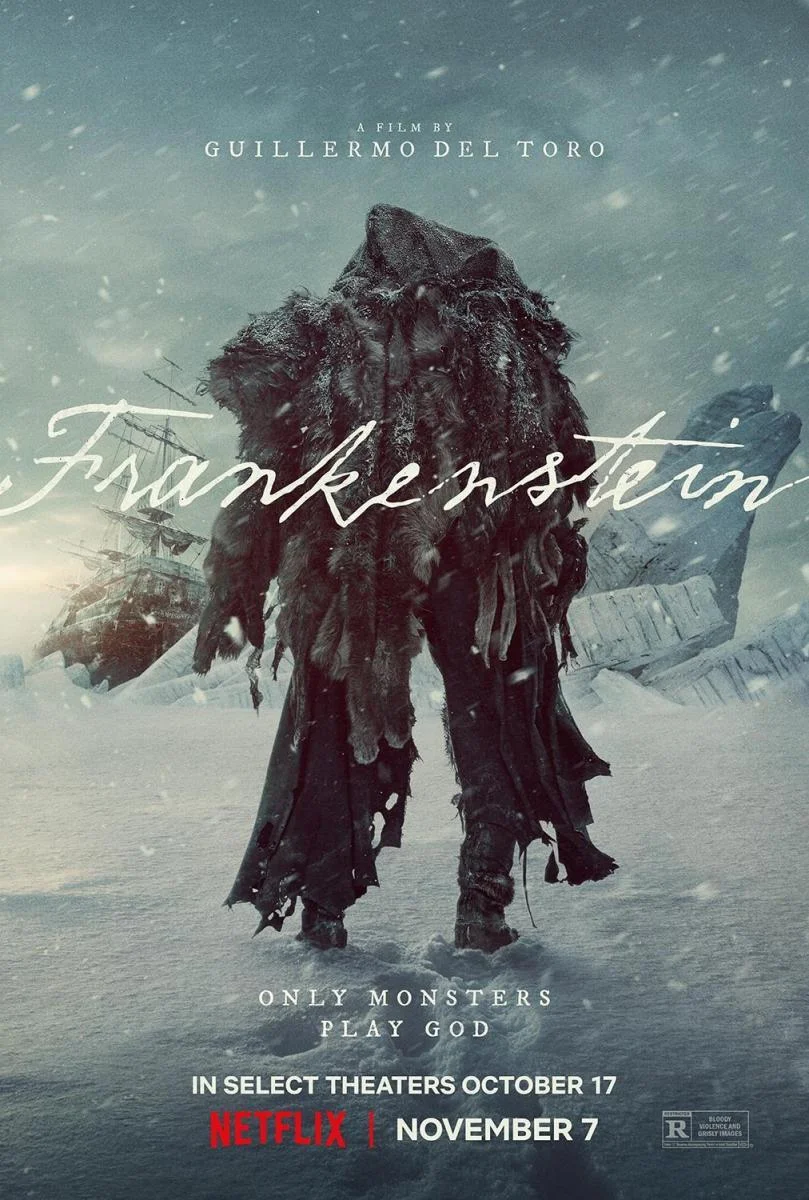
For years, I’ve wanted to watch something made by Guillermo del Toro. Everyone around me is always raving about his work, saying that everything he makes is so good and visually stunning. My list of “things to watch one day” basically contains everything he made at this point. But I never found the time and space.
Until now! I had written 6,000 words for a book and thought to myself “I’m tired and think I’ve done enough for today”. I suddenly had a few hours to spare in the evening, a rarity. And so I, finally, watched a Toro movie: Frankenstein.
This is not a full review. These are my quick thoughts on the film the day after. There are some very light spoilers, which I’ll clearly mark.
What’s the idea?
Victor Frankenstein, a brilliant surgeon, makes it his ambition to conquer death. For mysterious reasons, his brother gives him unlimited resources and help to actually achieve this. Victor builds a man from the parts of dead bodies and it actually comes to life: Frankenstein’s Monster.
What did I like?
The movie looked great. I have a bigger screen now—I don’t need to watch on my tiny terrible laptop screen anymore—which really makes a difference. I thought the whole movie looked stunning, while remaining easy to read and understand. There were only two moments when I thought the green screen/CGI was suddenly extremely noticeable, but that’s it.
In that same vein, the acting and music are great.
The music has this balance between more adventurous and “blockbuster-y”, and something more sinister and spooky. Because this is not a blockbuster action movie, it’s a monster story, a period piece tragedy really. But when Victor works and manages to create the monster, for example, the music has this slight “uplifting” feel too it. A kind of “achievement unlocked” music. But it stays just spooky and dramatic enough that it does not ruin the tone of the movie.
The story itself—the core of the story, really—is good too. That’s probably why it has been adapted countless times. It’s such a strong tale that carries massive momentum from start to finish.
- First half = work towards creating that impossible monster. A clear goal, clear progress, momentum.
- Then you get a spectacular midpoint where the monster is actually created. Nobody will put that story down, nobody will be bored now!
- Second half = dealing with the consequences of creating a monster. A clear goal, clear danger, momentum!
I’ve been calling these “classic stories” for a while now. And they are my favorite stories. Blockbusters keep your attention with cheap and superficial effects and explosions. Art house movies do not keep my attention by having nothing happen and being all abstract and philosophical. But classic tales have such a smart core idea that they create the best of all worlds: a tense, well-paced, dramatic, mature story with deeper themes, without needing any superficial stuff nor standing still.
I’d say a movie like The Prestige is a classic story too. Or the musical Hadestown. Hadestown is one of the very rare musicals where the first and second act are both equally good, which attracts people from all backgrounds and ages, and does so without any spectacle or superficial shock factor.
Combined with the skillful eye and hand of Guillermo, you get a movie that is enticing to watch from start to finish. Almost by default. Inevitably.
In that sense, the pacing was great. It’s a two and a half hour movie that never felt boring or sagged, even though there are long stretches without much “action” or “spectacle”. But, as I’ll explain below, I have some problems with the script and pacing too.
I did not have a problem with the “framing device”. The movie starts with a ship being stuck in the ice on an expedition to the North Pole. They find Victor, who tells them the story of the monster that’s coming after him. Several times throughout the film, the movie briefly cuts back to the ship and what’s happening there, whether the monster already found Victor.
Without giving major spoilers, I can’t say much else, but I think this fit the movie well and actually made it possible to have a kind of “satisfying resolution” at the end. Through hearing the story, the captain sees a bit of himself in Victor’s ruthless ambition, and changes his mind on something. It’s a tiny thing, but it actually makes the movie cohesive and gives it a stronger ending.
What did I dislike?
First of all, the movie is quite gore-y and graphical, when it does not need to be. I am not completely against this on principle or anything. I mean, I watched Game of Thrones and loved the first four seasons. But it seemed a bit pointless and out of place here. This is not really a horror movie, it’s explicitly not about making the “monster” a real monster, so why do this? It even made me look away a few times, because I had absolutely no interest in seeing such things happen on a screen before going to bed.
That said, the story of Frankenstein is very well-known. I have never read the book, never researched any of it, but I still know all the major beats and facts of the story. I suppose this is true for a majority of people. Especially the kind of people who will watch this movie. Namely, those who have always had an interest in stories or movies.
In my opinion, this movie does not add enough, or anything really, to explain its existence. I did not gain new insights. The theme of conquering life/death was not really expanded in unique or interesting ways. There wasn’t some major new perspective or twist that nobody saw coming. It is a very solid movie, do not get me wrong, but I see it as “a good looking, well-paced, modern version of the classic tale”.
THIS SECTION CONTAINS LIGHT SPOILERS FROM NOW ON.
That “framing device” I just talked about is, perhaps, the one unique thing it adds. And it works fine. We get Victor’s story first (which is about 2/3 of the movie), then the monster arrives on the ship and we get the story from the Monster’s perspective (the remaining 1/3).
Honestly, by the time we switched to “now we see the whole thing from the monster”, my first thought was “oh god the movie is not done yet”. It kind of felt like we were heading to a conclusion, even though I knew this could not be the end because we were missing large chunks of what happened. It was the only moment where I felt the movie was too long and I had to “reset” my expectations.
But the monster side of the story felt both too short and too long now.
I can’t help feeling the film would have worked better if the two stories were just intertwined. Told at the same time, told without trickery. Give both perspectives an equal amount of time.
If you’re going for “let’s hear the monster’s side” … then actually give that side as much (or more) time as the other one, to make sure you can properly show it. Anyway, that’s how I feel about that.
Finally, Elizabeth (the wife-to-be of Victor’s brother) is a weird character. I never knew what she was about in the movie, why she was there, and I found the scenes with her mostly boring and a distraction. I suppose she is the kindhearted opposite of Victor, which becomes clear once the monster exists and she treats him more like a human. But that’s the only impactful scene she has. I suppose Guillermo needed her already introduced to the audience, and so wrote her into the whole film from start to finish, but all her other scenes (and how she speaks/is portrayed) felt vague and pointless. Why introduce a sort-of-love-interest and sort-of-kindred-spirit-but-not-really-at-all, then do nothing with it, then have her die spouting some nonsense like she thinks the monster is a god?
Conclusion
The film looks and sounds great. The script is well-written. It has a solid pace that keeps your interest all the way through. The story of Frankenstein is a classic tale that carries intrigue and momentum from start to finish, basically for free. This movie tells that tale with a modern look and script, great acting, and a smart framing device (and small changes) that improve it.
At the same time, it could have been shorter. It could have been more balanced in the time given to different perspectives. It chose to make the monster more human, but also gave it far less time and skimmed over a lot, which felt like shooting yourself in your foot.
Finally, it did not really do anything new or unique with the tale. It was a solid watch that kept me engaged for two and a half hours. But when it was done, I did not keep thinking about any of its themes or events. My mind was content with what it had seen—a fine way to fill the evening—and nothing more.
Usually, when I watch a movie, my mind immediately generates ideas. Either the movie is very good and I get five ideas for great scenes or stories to write, or the movie is very bad and I get five ideas for how I would do it better or how I would fix it. With Frankenstein … none of that happened. I woke up the next day having forgotten I watched the film, but thankfully I always write a to-do list for the next day by hand to remind me ;)
The movie is not mind-blowing, it is also not bad in any of its components. If you have no clue about the Frankenstein story yet, though, then this is a solid (perhaps the best?) adaptation to introduce you.
Those were my thoughts,
Tiamo