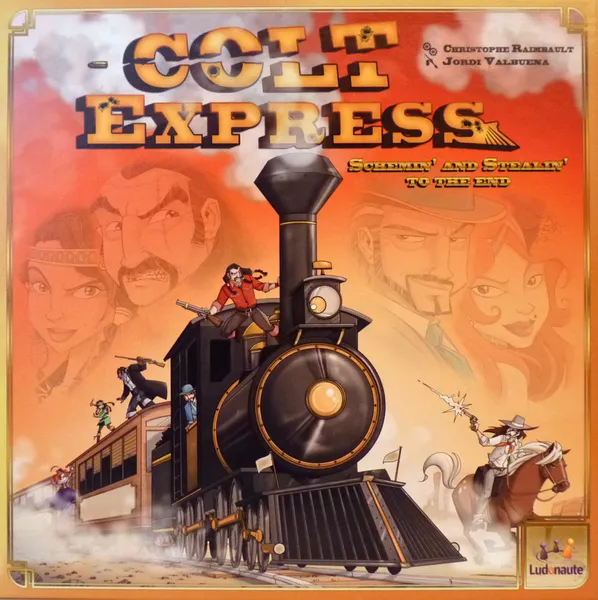
Gather up to 6 players to play out that scene in every action film where everyone fights atop a moving train! After you have, of course, punched out all the cardboard and built all the 3D trains for 30+ minutes ;)
Colt Express is the typical game that board game enthusiasts love to hate. Which is a shame, because in my eyes (as a game designer) it’s almost perfect. A classic that every family will enjoy, at any time, even if the game is only some 10 years old. It surprises me, actually, how few similar board games have been created since.
My Verdict
This is not a full review, but just a brief overview of my thoughts. I don’t really give “ratings” anymore, but prefer saying for which groups/situations a game is recommended, and for which it is not.
Colt Express is great for casual gamers, be it a family, group of friends, or even a classroom situation. Turns are extremely fast. It’s so interactive that everyone is involved at any time. With a few tweaks (more on that below), the rules explanation is only 5 minutes.
The game is great for hyperactive people like me. We prefer immediacy, we prefer loads of variation and possibilities, and we prefer having tangible 3D pieces to work with. This game has it all. All the cowboys are bumping each other, shooting each other, moving up and down train wagons. You have this amazing 3D train in front of you in which you’re constantly moving around, with no hidden information or rules to remember.
The game is not so great if you’re looking for something that’s very tactical and strategical, or if you’re playing at the lowest player count (2, maybe 3). The game shines through its high interactivity between the players, its silliness, just the right amount of randomness and funny mistakes. It is not a party game—it’s a step above that in terms of difficulty and strategy—but it’s also not a Ticket to Ride.
The game is also not great for people with … less steady hands. Think of (very) young children, people with a disability or arm injury, etcetera. I would have liked the trains and characters to be bigger, and especially the treasure to collect to be much bigger. Even with very steady hands you’ll knock over a few things and drop some money bags.
I made a joke in the introduction about how long it took to set up the game. Yes, it takes longer than usual to assemble all the trains and whatnot. But it’s not some ridiculous amount of time. I did it, on my own, as someone else set a timer and created dinner. When dinner was ready, I had finished reading the rules and assembling the entire game.
How To Play
You all play a cowboy in a train. Each player holds an identical deck of cards with actions to take like “move” or “shoot”. The train contains a lot of treasure: whoever collects the most by the end wins.
Each round,
- Take turns playing one card at a time. You are “planning” or “predicting” what you want to happen later. Because …
- Once everyone has played 3 cards, you turn the deck around and execute the cards in order. This actually moves everyone’s player according to what they prepared.
Now you can explain what each card does to the players.
- Move: move yourself to an adjacent train, or up to 3 spaces if on the roof
- Up/Down: move your pawn onto the roof of the train, or back down.
- Shoot: shoot someone in an adjacent train, or as far as the eye can see on the roof. Shooting inserts a bullet into their deck, which is a useless card. Thus, more bullets = worse hand = fewer good options when planning your turn.
- Punch: punch someone in the same space as you, which moves them to an adjacent train and makes them drop one piece of loot.
- Collect: grab one piece of loot in the same space as you are.
That’s it! Now you can play if you want.
The Rules I Left Out
These are all the rules I usually explain beforehand. But they are not actually all the rules of the base game!
As a game designer and part of a family of hyperactive people, I know two things. A shorter explanation greatly increases the chance people actually want to play and understand a game, and a shorter explanation is always possible (because not every part of the rulebook is “essential” to the game).
Below are the rules I left out for clarity, or in case you want to add some back.
- Marshall (Card): move the Marshall to an adjacent train. If you ever encounter the marshall, you drop loot, get a bullet, and are forced to go to the roof.
- Instead of playing a card (in the first phase of a round), you may also draw 3 new cards (if your hand is bad and you need more options).
- The game has special tiles that actually indicate how to play cards this round. How many? Should some be facedown ( = secret)? Should you go in reverse turn order? You draw a random one for every round.
- The player who shot the most bullets (successfully—they actually left your bullet deck) gets a significant reward: $1000.
All these rules make a lot of sense and improve the game. The Marshall is great fun and a nice neutral villain for all players. Encouraging players to shoot more is good too, because proactive risk-taking players are better than the alternative. But they are not essential, which is why I choose to lighten the load and just not explain them in the first game.
On The Right Track
The game takes about 45 minutes with a full house (all six players). It will be closer to 30 minutes on lower player count. This is the right duration for most audiences in my experience. An hour quickly feels like too long, while fifteen minutes is “did we even start playing?” territory.
Whatever your setup, whatever your players do, the game just works. For every player an extra train wagon is added at the end. This ensures the space is never too small or too big for your player count. You will run into each other. You will be forced to consider the worst actions players around you could take, and try to plan around that.
The 3D train, the tangible aspect of the game, makes it attractive to everyone. People look at it and are interested. They want to play. Many people never even realized board games could look like this, because they only know Monopoly and Catan. But they can! And it makes play immediate, and fun, like enjoying a toy box together, but with just enough rules to actually have strategy and meaningful decisions.
In case you hadn’t noticed yet, I like games that are fundamentally different at their core than other games. Too many board games are just the same game, but with different numbers or icons or values on the cards. You’re still “placing workers” or still “moving around a numbered track” or still “playing cards to a pile”. This game is different from anything else, and in a way that feels intuitive and matches with what players would expect the game to be about.
It feels great when your carefully predicted plan actually works out and you walk away with money. It feels equally great if everything goes wrong and you’re all laughing because a player punched empty air, then moved at the wrong time and ran into the Marshall, putting them back on the roof, where they are then accidentally shot by the next player because they’re closest in the firing line :p
The material is also great, by the way. The game could have easily used some cheap ugly plastic trains (like many others), which often falls apart after light usage, but it did not. It uses solid cardboard that you assemble yourself into a simple train. If anything breaks or gets loose, you can just reassemble that yourself. But in all my plays I’ve found it to be surprisingly sturdy. The alternative would have been wooden trains, but that would be overkill as the box would get far too heavy and expensive.
Off The Rails
Where the game goes wrong, only a tiny bit, is in the complexity of those base rules. My simplified version (explained above) is the same core game, but shaves 5 minutes off of your explanation and prevents overwhelming players.
A silly game like this really does not need the extra little rules and exceptions in the base game. Expansions and variants? Absolutely fine. It adds player roles, it adds scenarios, there is even an expansion with a second train. All great. But the base game—the thing you need to play first before people are on board and realize how cool this is—should absolutely be simpler.
My other gripe is that the game could have added a simple rules reference card. Each action card + illustration of what it does. The biggest hurdle with the game is the fact that you ask players to remember 5 or 6 different cards and exactly what they do before they even start playing. That’s too much information to really grasp until you’ve played out that first round.
I mean, the game even includes role cards as an alternative to role boards. It tells you to use those cards if the boards are too large and don’t fit on the table. It could have easily printed some reminder on those role cards instead, or added 6 more cards to that deck.
And I guess, sure, you could wish for more strategy or control. That’s why I mentioned many board game enthusiasts do not like this game and don’t want to play it. They’ll say things like “it’s all random!” and “it’s a silly party game!” and “the game is too dumb for me!” To which I will always say: “look at us, all having tons of fun with little effort, oh how terrible” Colt Express is a required game in any board game collection if you ask me, because it is so different from other games, and it’s an accessible party game without being an actual party game.
I feel the core game has enough strategy, and the expansions and special roles add a little more, and that’s enough for me. This is just not the right game for it. This is a game that thrives in chaos and unpredictability, and I’ve even found that players who think for too long and plan their turns too precisely just drag the whole experience down. So no, the game’s level of strategy is perfect as it is, and you should just not play it with those who want something thinky, something to sink their teeth into or be rewarded for genius tactics.
I sincerely hope more game designers will design something in this vein. A truly tangible experience with a really strong intuitive core. I mean, you could literally move this game to a space station or whatever. But I’m sure there are many other ways to “plan moves together/ahead of time” or “interact in silly ways on a 3D board”. I might even design some myself …