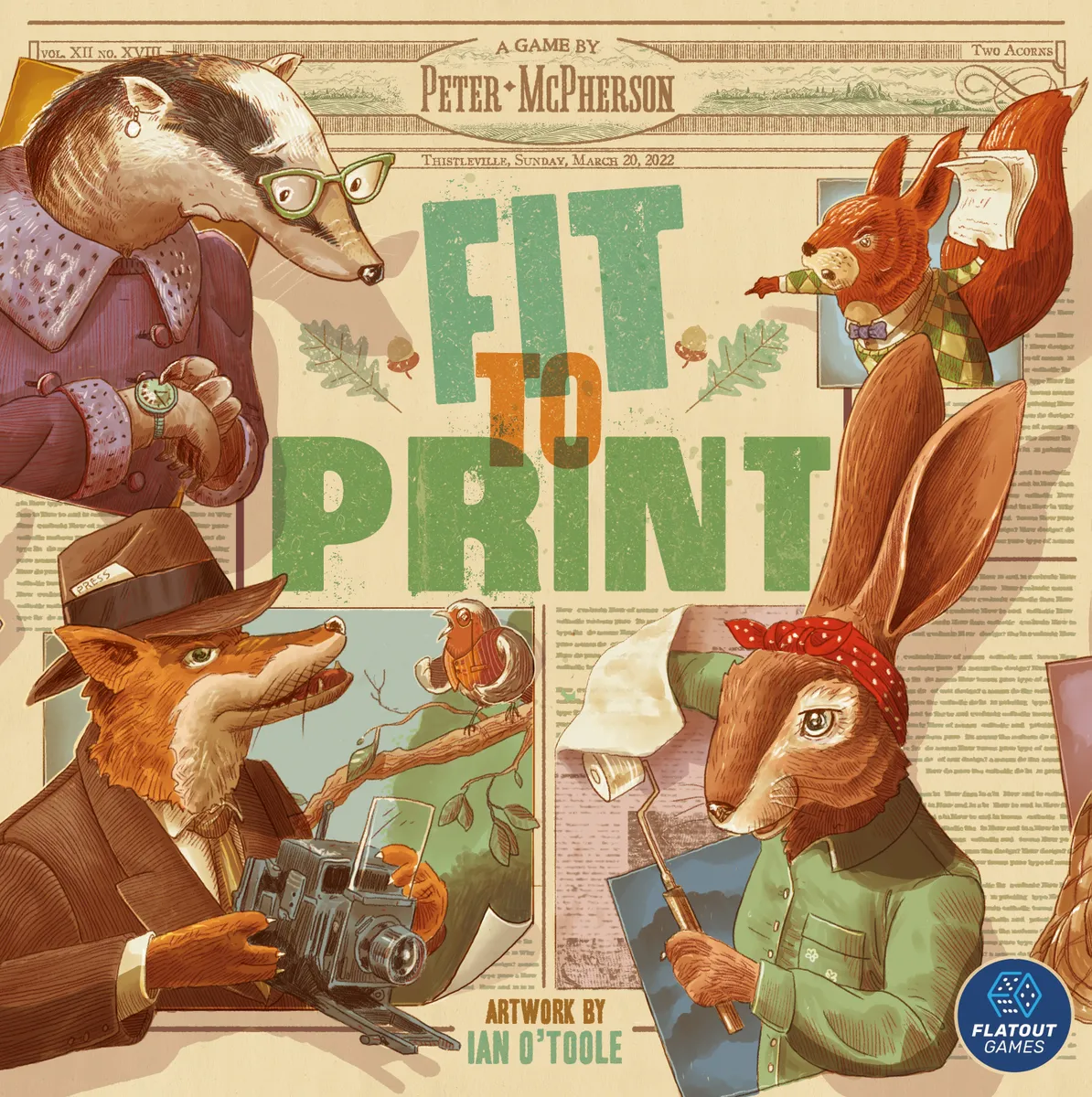
Ever dreamed of living in a cute forest and delivering your wholesome newspaper to all the critters? Forget that dream! Because creating a newspaper is hard, you want as many sad stories as happy stories, and all the other players are stealing the articles you need.
As I stated in my reviews of Colt Express and Wandering Towers, I come from a family of hyperactive gamers. Our brains move too quickly to be interested in simplistic (“party”) games. But we’re also too restless to play any big games that take too long or require 10 minutes of rules explanation.
As such, I’m always on the lookout for games that perfectly fit my group. Fit To Print fits that bill perfectly. (Man, I’ve never typed the word “fit” this often in a single article!) It has simultaneous play, which just means there are no turns and you all act at the same time. This is amazing for cutting down play time and boredom, and I wish more games leaned into this.
My Verdict
This is not a full review, but just a brief overview of my thoughts. I don’t really give “ratings” anymore, but prefer saying for which groups/situations a game is recommended, and for which it is not.
The game is great for any group of casual gamers. It’s tangible, it’s cute, it has a nice forest animal theme, it’s a unique topic (building a newspaper) that is still familiar and not off-putting for players. (I mean, “design an office chair” is also a niche topic, but who is going to be interested in that theme?)
The game is great for hyperactive people like me, but with a caveat. There’s a lot going on in this game. Lots of tiles, lots of moving pieces, different types of articles, etcetera. Hyperactivity is a spectrum, of course, so this might not be an issue for you. But the amount of stimuli and moving parts can easily overwhelm you if you’re sensitive to that. For me and my group, I’d describe the game as being at the edge of our “sensory allowance”. If the game had even more parts or different kinds of tiles … then it would probably have overwhelmed most of us.
The good part, of course, is that there’s a lot of variety and randomness. The big chunky tiles are nice to grab, hold, move around, look at. It’s all very immediate and tactile. No two newspapers will ever be the same, no two rounds will have you draw the same tiles, and it always remains an interesting puzzle that you can just about hold in your head.
The game is great for large player groups. It plays up to 6. It even plays solo! There’s very little interactivity between players, so I don’t think the game really changes depending on player count. Not even the duration changes because of the simultaneous turns. The only downside for large player counts is that counting your score after each day takes longer than I’d like—more on that soon.
The game is fine for people who want something more strategical and thinky, although with another caveat. There is, of course, time pressure. This severely limits how tactical you can actually be. The actual puzzle of picking tiles, laying them out just right, and so forth is really thinky and rewards quick and smart calculations. There is no “randomness” in that sense: you completely decide what you pick up and use, and where you place it.
The game is not great for players who want high interactivity. Your only interactivity is grabbing from the same massive pool of facedown tiles—so not that relevant—and the fact that the poorest player is out of contention for winning at the end. Everything is just … eyes on your own newspaper.
The game is not great for the youngest kids or for those who never played a board game before. The placement and scoring are complicated enough that I really would not recommend trying to teach it to kids who can not or can barely read or count.
It’s a very “game-y game”. A stupid phrase that’s the best I could come up with right now. It means that the game uses a lot of typical mechanics and rules familiar to regular board gamers that will not immediately make sense to anyone else. If you’re familiar with board games, then this game is simple to teach and play. If not, the rules are not that intuitive, strongly tied to theme, or similar to something people will be intimiately familiar with from real life.
How To Play
Set a timer for the round. About 3 minutes is the highest difficulty, 5 minutes for a more relaxed (first) game.
While the timer runs, each player tries to fill their newspaper.
- GRABBING: First you grab tiles. Pick one, place it on your table, flip it over. If you don’t like it, put it back now.
- PLACING: Once satisfied with the tiles you have, switch to placing. Try to fit them all onto your newspaper tableau, following all the rules and trying to score the most points.
It’s up to you how long you spend on each phase, because the timer is just for both.
So, what are the rules?
- Your headline article must be placed and it must cover the star. (This is a unique article, different between players, that gives some bonus for doing something special. Like “+1 Point for each Green Article above the fold”.)
- Articles score their point value.
- Photos score for being next to specific articles. (Ex: “+1 Point if touching Green or Pink article.”)
- Adverts give you money.
- Tiles are not allowed adjacent to tiles of the same type. Photos can’t be next to photos, adverts can’t be next to adverts, and same-color articles can’t be next to each other. (Orthogonally that is; diagonal is fine.)
What else influences your score?
- Whoever has the most empty space (“wasted space in the newspaper”) gets -3 points.
- Any tile you ended up not placing scores -1 point.
That’s it! Score people, move tiles back to the center, play the next day. Move from Friday -> Saturday -> Sunday, eliminate whoever has the least money, highest scoring player wins.
The Rules I Left Out
I actually left out and changed some rules in my explanation. As a game designer, I know that many rules are not “essential” and will just confuse or bore players. My “teach” of the game is always cut down to the bare essentials. Absolutely nobody has ever complained or even noticed, while people have noticed that I explain games better than I did 10 years ago.
I’ll give the rules (for the base game) that I left out below, for clarity and completeness’ sake. You can pick and choose what you want to explain yourself.
- As you move from Friday -> Saturday -> Sunday, your newspaper area gets bigger so you can place more. => A very simple rule, sure, but I was surprised about how many people kept forgetting this, getting confused by it, accidentally using the Friday bounds when it was Sunday, etcetera. So I just put everyone on Sunday side and ignored this rule in the first game explanation.
- Subtract the difference between HAPPY and SAD article icons from your score. (Ex: You have 2 happy articles, and 1 sad, then your score changes by -1.)
- Tiles with text must keep that text from left to right. In other words, you can’t just rotate an article and have it read from top to bottom or upside-down. Because, well, newspapers also don’t do that for obvious reasons. => This is not a hard rule, but it’s the kind of rule everyone forgets in the heat of the moment when playing that first game. They end up with a newspaper with articles all wrong and it’s just not great to have to disqualify all that.
- Empty Space points are a little more complicated. You only check the “biggest connected area of wasted space”.
- Biggest Wasted Space = -1 point
- Smallest Wasted Space = +3 Points
- Anyone in-between = -1 Point
- You actually must call out when you switch from GRABBING to PLACING. Furthermore, when you finish placing, you grab the lowest remaining TURN TOKEN.
- This is used for tiebreakers, because whoever finished first wins that tie.
- It’s also used to pick the order in which people may pick their next headline article for next round.
As always, these are not terribly complicated rules. But they’re the “one thing too many” that causes players’ eyes to glaze over, causes the explanation to run two minutes longer than people can accept, etcetera. If at all possible, I always recommend just leaving them out and introducing them when you play another game.
Breaking News
Let me say, first and foremost, that everyone enjoyed this game. I enjoyed it too, even though I lost in quite a dramatic fashion because I kept underestimating the amount of space I had in my Saturday and Sunday newspaper.
The simultaneous turns means the game moves very fast and you’re always busy … or, at least, it should. My main issue is with scoring.
- The scoring rules are slightly too complicated, hence why I simplified them in the section above.
- Even so, they remain too complicated for all players to score themselves. (Setting aside the issue of “do you trust players to be honest about this and/or not make mistakes?”)
- This means one or two players are required to score everyone’s paper, one by one. This takes longer than desired and is prone to errors. (Better for players to calculate their own score, and then a second eye to check and confirm it.)
- Meaning you’ll spend more time calculating score than actually playing.
I would not call it a mistake or anything that “ruins” the game, but it is a weird choice. In a game made to be fast and accessible, you don’t want scoring to be so complicated that it comes to a complete standstill after every round (“day”).
Now the game lingers between “fast and frantic fun” and “serious scoring puzzle”, undecided which one it wants to be. The placement and scoring rules are much too involved to make scoring fast and obvious, but the gameplay also isn’t so clever that you really want to take the time to sink your teeth into this great puzzle. It’s 3–5 minutes of grabbing tiles and hoping for the best, then 5 minutes of scoring everyone and being surprised by your own score.
I think the game improves a lot if you shove it clearly in one direction.
- Either make the timer much longer and involve the full scoring rules.
- Or simplify scoring to the basics so the quickness and lightness of it matches that of the rest of the game
Which brings me to my next point, which is that I sense a lot of missed potential in this game. If it wants to be a puzzle, with strategy and clever placement decisions, then it could have expanded on that idea more.
- Maybe the money you earned from adverts could be spent to buy cool stuff for your newspaper the next day.
- Maybe reputation matters. Or articles are connected and you can do follow-up stories in later papers, for massive points, if you manage to find exactly that tile …
- Maybe you could have found a way to only score people once at the end, instead of three times (after each round). Some system to spend more time playing and less time scoring.
- In general, it would have been more fun if your newspaper was actually an entity. If there was some persistence between the days and the content of your newspapers. If there was a bit more interactivity, longevity, and long-term strategy to really make the scoring worth it.
I admit that myself, and my usual playing groups, are an impatient bunch that thinks every scoring rule is one too many to remember. I know these rules won’t be a problem for many (regular) board gamers. But I can only speak from personal experience and game design knowledge, and it clearly tells me that such a long list of scoring and placement rules does not match the fast simultaneous nature of the actual game. Especially when executed three times in a single game.
My second issue is simply one of visual design. The icons are tiny and not always very readable. Especially on things like photos that say “+1 point for Green/Pink article”, those icons are reaaaaaally tiny and a reaaaaally big problem for anyone without pretty good vision. And that is, again, a shame, because the rest of the game looks really cozy and fun and polished.
Conclusion
The core of the game—simultaneously grab tiles and lay out a high-scoring newspaper—is really fun, intuitive, and appealing. An instant hit with everyone, no questions there. The puzzle of getting all the tiles and positions right is really challenging.
The fact that the game has a large solo mode says enough: the puzzle is even interesting when you have no time pressure or competition. That part is well done.
The issue I clearly noticed was the three scoring moments (after each day). The game suddenly stops completely, people get distracted or get up, and you’re not playing as much as you’re playing. As stated, either simplify scoring to match the pace of the game, or change the pace of the game to match more intricated scoring :)
With simplified scoring, the game might also be suitable for young kids or very casual board gamers too. The actual gameplay is simple and intuitive enough for that—it’s just the numbers and the scoring that trips people up. In fact, one of us brought her kid over (4yrs), and they simply “helped” one of the teams by placing and grabbing tiles. It was just a toy to them—and let’s just say that team did not score too well—but they loved being part of game and loved playing with the tiles.
And that’s what it’s all about, is it not? The game is a simple, accessible way to have fun with any group of people. A puzzle that remains interesting no matter the intensity at which you approach it. Gameplay that literally means scrambling together for 5 minutes, grabbing tiles, flipping tiles, putting them back, shoving them around, without a dull moment.
In a way, you can just drop the tiles and papers on a table, and people can have fun with out in whatever way they like. Figure out their own scoring or placement rules.
The visual design has some very tiny icons and numbers. It was not a big issue for my group, but none of us are colorblind and we have okay eyesight. (I was tempted to say we’re young and have good eyes, but this is unfortunately not true at all anymore, not for me or the group :p)
Those were my thoughts, keep playing,
Tiamo Pastoor / Pandaqi