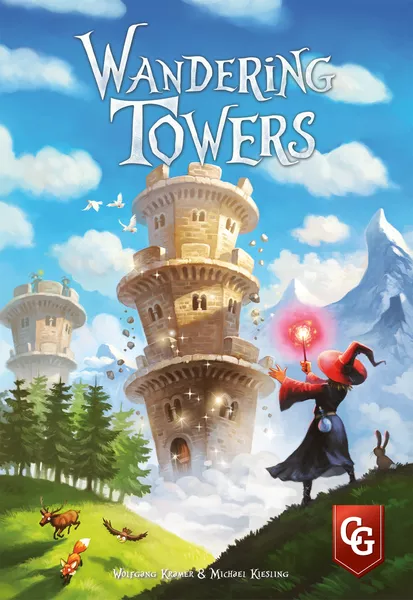
Trap your friends beneath a tower, forget where your own pawns are, and accidentally release them again when a stack of nine towers goes flying off!
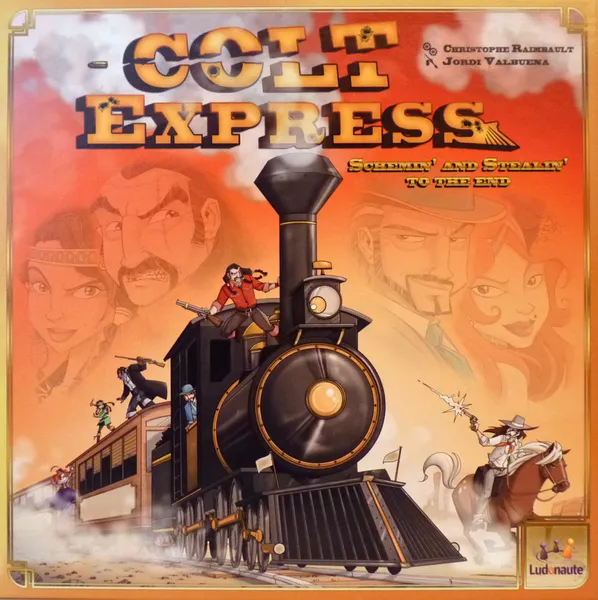
As I stated in my review of Colt Express, I come from a family of hyperactive gamers. Our brains move too quickly to be interested in simplistic (“party”) games. But we’re also too restless to play any big games that take too long or require 10 minutes of rules explanation.
As such, I’m always on the lookout for games that perfectly fit my group. Wandering Towers had been on my radar for that reason, since it came out, and I was finally able to get a copy and play it at birthday.
My Verdict
This is not a full review, but just a brief overview of my thoughts. I don’t really give “ratings” anymore, but prefer saying for which groups/situations a game is recommended, and for which it is not.
The game is great for any casual group of gamers, including young kids. One could even use the game to teach numbers/counting in a classroom setting. It is absolutely simple enough, while the theme and mechanics are not off-putting or only applicable to some very specific audience. It’s a game clearly designed with kids and family in meant, but it’s not “childish”.
The game is great for hyperactive people like me. Turns are snappy (just play two cards and do what they say). Every turn has you physically moving stacks of towers or pawns. This makes the whole game very tangible and immediate.
Because of these quick turns, absurdly high interactivity, and physical 3D board, the game also works well on high player counts. (It plays up to 6.) Even when it’s not your turn, everything that happens interests you—people might move or cover up your pawns, and you need to remember where they are. Even when it’s not your turn, you have a nice set of towers in the center of the table to look at.
The game is not so great for people who want something highly strategical or thinky. Yes, there’s a lot of randomness here. Not only that, the high interactivity gives other players a lot of control over your pawns and moves, restricting you further.
The game is also not great for people who are bad at (or dislike) memory games. Although it’s not a true memory game, you will have to remember which exact tower contains which of your pawns. This is much (much) harder than it seems, believe me. Towers stack onto other towers, the entire stack might move, even the final tower (where you have to deliver your pawns to win) can go on top and start moving a lot.
A common occurrence in the game is a turn that goes like this,
- “Okay, all my pawns are covered, but I’m pretty sure this one contains "
- Player carefully moves the right tower off the top of a stack. There is nothing underneath.
- “WHAT? Where IS my pawn? It should be here! Okay then, maybe it’s there.”
- Player plays a second card, moving some other tower and revealing pawns underneath, accidentally helping all other players except themselves.
- “WHAT? WHERE ARE MY PAWNS!?”
If you think that’s funny, this is the game for you. If you think that’s annoying and stupid, then this is not the game for you.
How To Play
Setup the towers and pawns as instructed. This is not “obvious/easy”, but it’s also not hard. These setup rules ensure a fair start, so I do recommend following them instead of plopping down towers and pawns randomly. Also, every player holds 3 cards and 4 empty potion flasks.
You win by getting all your pawns into the black tower and filling all your potions.
Take clockwise turns. On your turn, play 2 cards. A card either …
- Moves any tower (by X spaces or dice roll)
- Moves a pawn of yours (by X spaces or dice roll)
- Or shows both and you may choose which one you do.
Whenever you cover another player’s pawn (by moving a tower on top), you get to refill a potion.
You can’t place a tower on top of the black tower. When you land inside it, the black tower moves to the next empty space showing the shield sign.
That’s it!
The Rules I Left Out
At least, that’s all I explained to my players. As a game designer, I feel qualified to leave out any rules that are not essential for the very first game :p In all seriousness, this has cut down explanation time (and confusion from impatient players) tremendously, without losing anything of value. You can always play the more “deep” or “complex” version next, once everyone has understood the base game.
For clarity and completeness, I’ll list the rules left out.
- There are special spells. You can pay 1 or 2 (filled) potions to execute such a spell on your turn, which basically gives you some unique power that might be the exact thing you need. (Like moving someone else’s pawn.) => Very nice system, but not essential. When I DID explain this rule, nobody used any spell in the first game anyway.
- There are cards with multiple dice icons. It allows rolling multiple dice and deciding when you’re happy with your value. => Again, not essential, and this symbol confused a surprising number of people. They’re tiny symbols, and some show 2 dice, and some even 3 tiny dice, which is just hard to see and a bit meh.
- There’s a maximum of 6 pawns per tower. => Again, in none of my games was this value exceeded anyway (without explaining the limit), so just leave it out.
- When someone finishes (all pawns in black tower + all potions filled) you still play out the round so everyone has equal turns. => Not essential. The starting setup is already balanced, this “play out the round” tends to confuse people, and it can lead to annoying tiebreakers if someone else ALSO finishes now. Many people actually feel it’s “not fair” if someone can still win though they finished later. Human psychology, what you gonna do bout it.
I immediately identify rules like these as not essential, but also as the “one too many”. These are the kinds of rules that might only be a sentence or two to explain, but when added to the rest of the explanation, it’s too much and creates the situation of overwhelm/confusion in your players.
Interesting Notes From A Designer
It goes without saying that I think the game is great. It’s so simple to teach, it’s so tangible, it’s so rewarding to remember things correctly and find a clever way to shuffle towers/pawns to arrive exactly at the black tower (and at the right time).
Everyone I played with immediately understood. Within a round or two, their pawns were getting lost, they enjoyed creating massive stacks of 6+ towers, some even allied to move towers in such a way that they both benefitted. It looks great on the table because of that 3D presence. It’s silly and fun, but also tactical and serious enough to appeal to basically any crowd.
Now, as a game designer, I want to give some thoughts about why it works so well. The clear rules and decisions that I immediately identified as clever solutions to problems by the designers. Maybe this is fun to read, maybe it helps you design your own games, or maybe it helps you explain/play/introduce this game better.
Clever Idea 1: The fact your potions refill when you cover other pawns. You’re clearly incentivized to annoy other players and trap them as much as possible. Without this rule, you’d probably have lots of little towers with pawns clearly on top, ruining the core aspect of memorization and stacking that the game leans on. It’s such a clever solution. It also prevents requiring any extra material or mechanics for this. It simply reuses what you already have and want to do.
Many other games might have tacked a second system onto the rules. Maybe some money component or whatever to fill your potions (or buy filled ones). And then maybe they would have punished you for getting covered up, whilst what you always want to do is reward people for doing the covering up. This is true in games as well as life, actually. Do not punish players for bad behavior; reward them for good behavior (proactive, interesting, and smart).
Clever Idea 2: Moving the black tower whenever someone finishes there (and forcing you to finish there exactly, but that’s quite standard). At first I thought it was a bit gimmicky, just adding even more randomness when it wasn’t needed. After playing the game, however, I realized it cleverly solved some problems.
- It makes it impossible to just collect all your pawns in the same place and finish them all in one go when the time is right. After finishing one, the tower moves to the next space. Conversely, it makes it impossible to get stuck far away from the tower, because it’s not rooted to some place on the board—if you wait long enough, it will automatically come nearer. The tower moves in a way you can control, if you want, which means …
- … the tower actually incentivizes keeping your pawns and towers spread out. It helps you finish in a chaotic, spread-out situation—which is the most common situation in the game!
- I actually used this to win my first game, when I suddenly realized the strategy and control behind this. I thought I was doomed and had to walk the entire circle to finish my final pawn. But then I realized I could get the black tower to move past me. Overtaking my last pawn, so it was suddenly just two steps behind it and could walk home.
A very simple rule that is silly and fun, but also solves a lot of problems and opens up surprising strategy.
Clever Idea 3: Re-using the potions for powerful spells. This adds a lot more variation and control to an otherwise quite random game. But it also adds strategy: you will lose some filled potions to get that powerful spell. So, do you think it’s powerful enough to quickly refill those potions later? Or is it not worth it?
This, again, uses no extra material or mechanics. The game is just towers + pawns + potions and they all combine into this wonderful system where each part is crucial.
This also is an example of an “inflatable mechanic”. I invented the term on the spot, but I like it actually. Maybe “balloon mechanic” is even more fun. You want at least one or two balloon mechanics in your game, which means it’s a rule that you can expand endlessly to add more variety and strategy to the game. It’s a rule or system that can be present in the base game if you want, in simplified form, but can be expanded and expanded without change to make the game more interesting as you go.
The spell system is such a balloon mechanic. The base game recommends using just the two most basic spells (move tower, move pawn). But there are 12 spells you can choose from. You can always expand by inventing more spells (as a designer, or just as house rules)! If you ever get bored of the game, this mechanic has room to grow without requiring more rules or annoying exceptions. A balloon mechanic, thus. They’re nice.
Final Note: You play two cards on your turn. This might not seem like a big deal. But when I was younger, for the longest time, I somehow thought that this was weird. I only knew card games where you play a single card on your turn (most of them!), or you get to decide what and how many you play (in more complex Eurogames for example). And so I kept designing games that did not really work … and it took me far too long to realize it was because of the “play 1 card”.
You see, if the game and cards are simple enough, playing a single card is not enough of an action. If, in this game, you only played a single card on your turn … then you could only move one tower or one pawn. Then you’d have to wait for your next turn, during which time the board would dramatically change. You can’t “setup” your next turn in a game with such high interactivity. You need that “1-2-combo” to actually get something done on your turn. And so, the simple solution is just to “play 2 cards in a row on your turn”.
So simple. So obvious But somehow younger me refused to see this possibility and wasted a lot of time looking for solutions elsewhere in my game design. Lesson Learned: if the game state changes drastically between turns, allow players to do more in a single turn so they can actually achieve stuff.
Conclusion
Wandering Towers plays a bit more quickly than Colt Express. It also requires fewer rules to explain and is quicker to set up. In return, you actually get a bit more strategy and thinkiness. So that’s a good deal, right?
I compare these games because I bought and played them at the same time (on my birthday), but also because they feel like they’re the same subgenre. Tangible accessible silly game with high interactivity and randomness. A party game that’s not actually a party game.
Colt Express has more of a … “vibe”. Its theme is more apparant and something players really get into, including silly cowboy accents and what not. It’s sillier, it’s funnier, it has more variety in actions and consequences.
Wandering Towers is more of a 3D puzzle. Its theme does not really matter. And, in the end, all you do is move a tower (/stack of towers) or a pawn. But with such simple rules you still get high interaction, moments of great triumph (perfectly getting your pawn home) or great laughter (when you can’t find your pawn for the third time).
Whereas Colt Express adds a bunch of unrelated rules and actions because of its theme and chaotic tendency, Wandering Towers does the opposite by removing rules and chaos until an elegant core puzzle remains.
Which one do I like more? I have to say Colt Express and I think my family agrees. We’re all intuitive people, we go by “vibe” and “story” and “roleplaying” a lot. But we enjoyed Wandering Towers a lot too. Some time later, when we had very little time left to play a game, that’s the game people proposed because it’s just a bit simpler, faster, and more elegant in its design.
Those were my thoughts, keep playing,
Pandaqi / Tiamo Pastoor