These past few months I’ve invented several “cozy crime puzzles” that I think are very fun and interesting. I released the first volume for both Murderooms and CrossMurds!
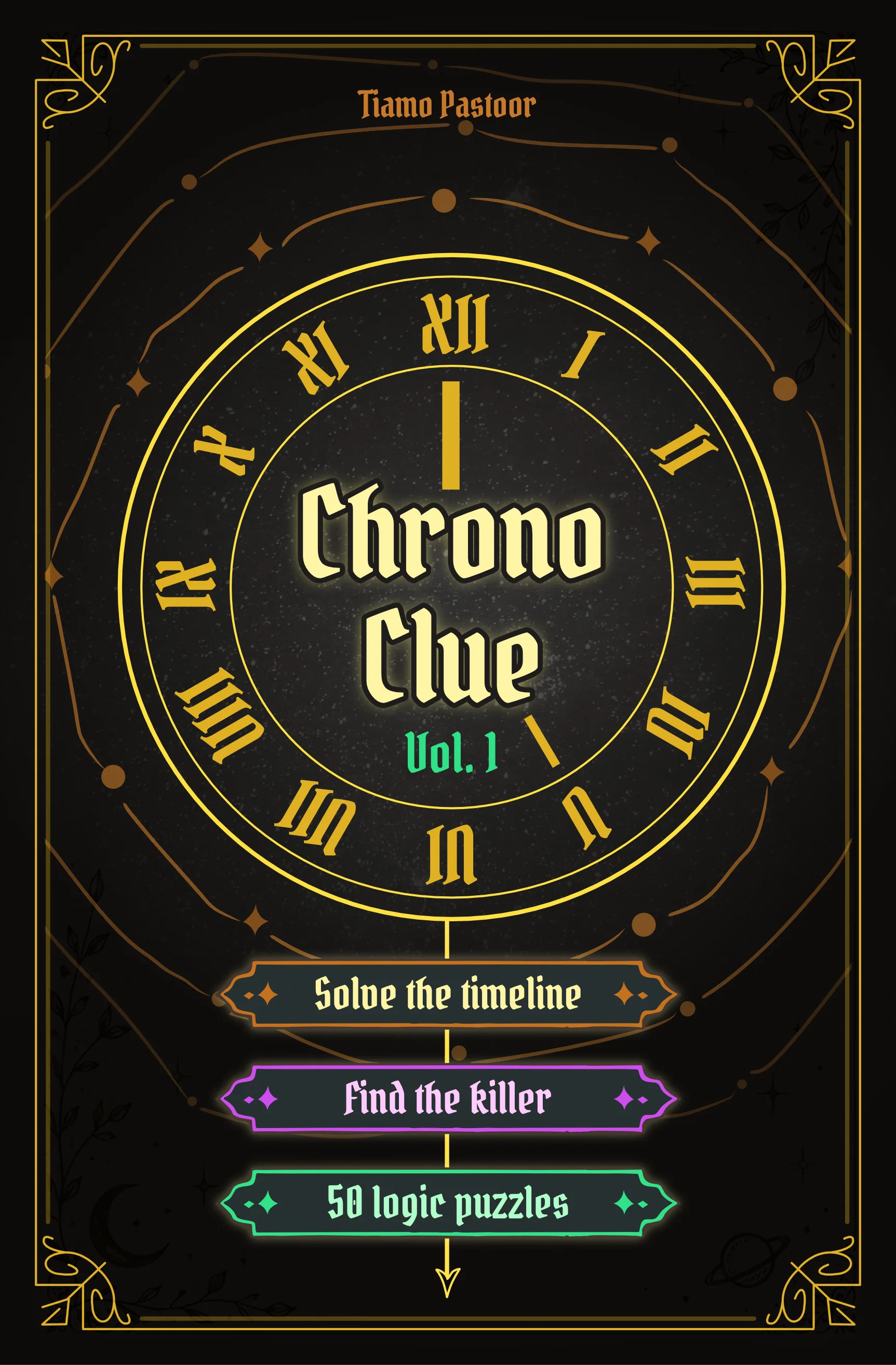
But my brain wasn’t done imagining exciting new murder mystery puzzles. And so I complete the trilogy with ChronoClue!
You can buy it on Amazon (and other places): ChronoClue (Volume 1)!
What is ChronoClue?
My other two puzzles are language-based. This creates a certain “fuzziness”, because the meanings of words and their relationships are a bit subjective. Unless I give extremely basic and strict clues for a crossword puzzle (“Animal”), there’s a chance a puzzler gets frustrated because their brain just interprets the clues and words differently.
Additionally, this means those puzzle books can only be enjoyed by English people. If I ever release other languages—such as Dutch, my native tongue—I’d have to create completely new puzzles. I can’t just “translate” them and call it a day.
That’s why I wanted to make (at least) one puzzle that’s purely based on logic!
After some thinking and searching, I noticed a surprising lack of “timeline puzzles”. It made a lot of sense to me.
- I present a timeline.
- I give the puzzler clues about where people were at what time. (“Dan was never in the room with Lisa.” or “Lisa arrived after 9 o’clock.”)
- By considering clues, thinking logically, making some deductions …
- … they can solve the timeline!
It wouldn’t be a “cozy crime puzzle”, of course, if there wasn’t a crime. This is why I was surprised to find no other timeline puzzles—because they are perfect for that! Murder mysteries are literally about “WHEN and WHERE did it happen?” Filling in the timeline answers those questions.
So, what is ChronoClue?
- Solve a timeline …
- … to find whoever was in the room with the victim when they were killed
- They must be the murderer! Case solved!
It’s simple, it’s clear, it’s fun to solve, and it just works.
Designer Notes
Well … it works in the eyes of the puzzler. I must admit that it’s hard to come up with these puzzles as the designer.
How do you solve an entire timeline with just 3 to 5 very simple clues!? Making a physical puzzle book gives me clear restrictions, which is nice, but also requires more time and effort to work within. That low number of clues (max 5, often less) and simplicity of clues (just one line, one detail) was a hard restriction I set for the puzzle right from the start. And the clues should not be TOO good, because that makes solving the puzzle obvious and boring.
All of this made me create 50 interesting puzzles, but it’s also why this book was the last one to be finished ;)
Ever since finishing it, I had a few ideas for clear improvements on the topic. This included, for example, ways to make it more educational so it fits on my educational online store. Timeline puzzles are obviously ideal when teaching history!
There will be more volumes of this, but they’ll take some time and probably look quite different from this one.
I hope people enjoy these puzzles and that it inspires others to create more timeline puzzles too.
Until next time,
Tiamo